Ahrefs vs Semrush 2026: Which Is Better for Small Business?
📅 Last Updated: April 2026 ⏱ 14 min read
Ahrefs and Semrush are the two most recommended SEO tools on the market – but they’re built for different priorities. Choosing the wrong one means paying for features you won’t use. This article compares Ahrefs and Semrush head-to-head across 8 criteria – keyword research, backlinks, site audit, content tools, rank tracking, ease of use, integrations, and pricing – to help small businesses choose. Our review combines official product docs, verified user reviews, and an AI-assisted editorial analysis reviewed by a human editor using our “5-point review methodology“.
Table of Contents
Ahrefs vs Semrush – Quick Verdict
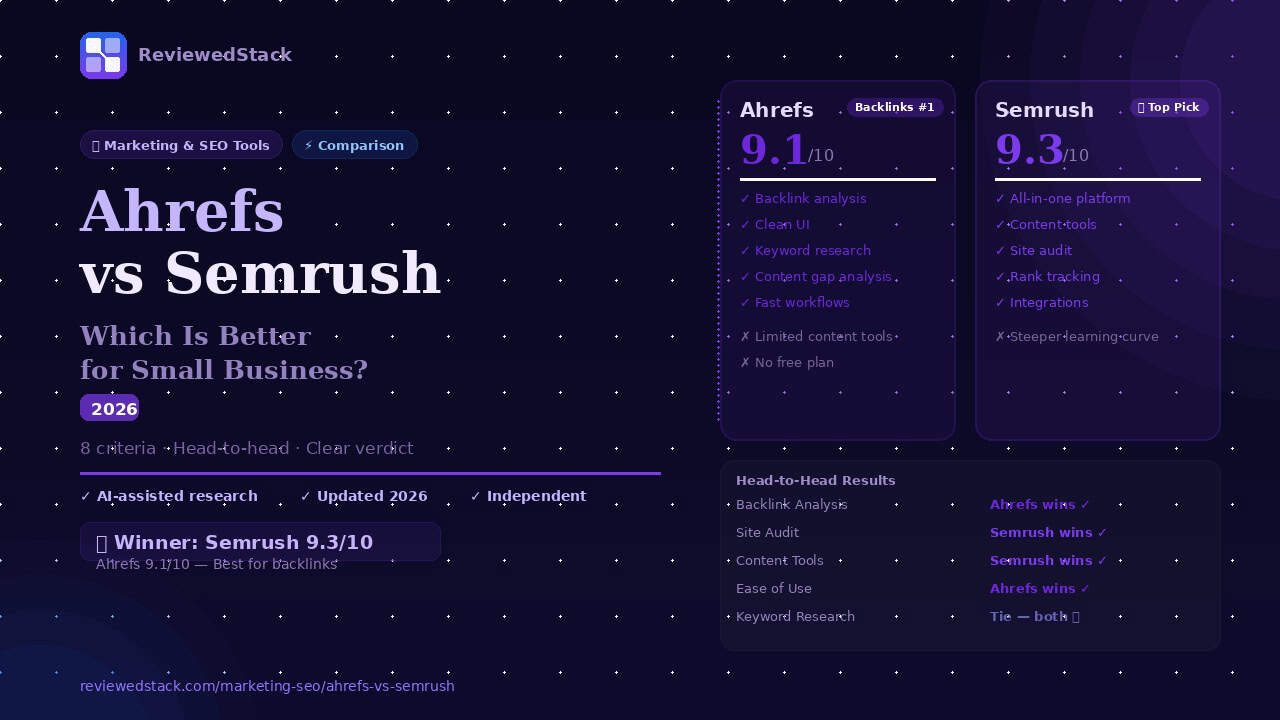
Ahrefs is the better fit if your priorities are link building, fast competitive research, and a cleaner UI for focused SEO work. Semrush is stronger if you need an all-in-one marketing platform that combines technical SEO, content workflow, PPC insights, social, and broader integrations for teams.
Side-by-Side Comparison Table
| Feature | Ahrefs | Semrush |
|---|---|---|
| Starting Price | $129/mo | $139/mo |
| Free Plan | ❌ Trial only | ❌ Trial only |
| Keyword Research | ⭐⭐⭐⭐⭐ | ⭐⭐⭐⭐⭐ |
| Backlink Analysis | ⭐⭐⭐⭐⭐ | ⭐⭐⭐⭐ |
| Site Audit | ⭐⭐⭐⭐ | ⭐⭐⭐⭐⭐ |
| Content Tools | ⭐⭐⭐ | ⭐⭐⭐⭐⭐ |
| Rank Tracking | ⭐⭐⭐⭐ | ⭐⭐⭐⭐⭐ |
| Ease of Use | ⭐⭐⭐⭐ | ⭐⭐⭐ |
| Integrations | ⭐⭐⭐⭐ | ⭐⭐⭐⭐⭐ |
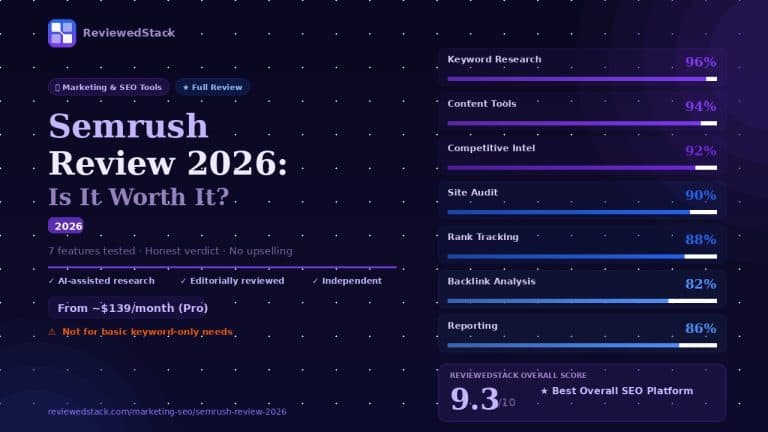
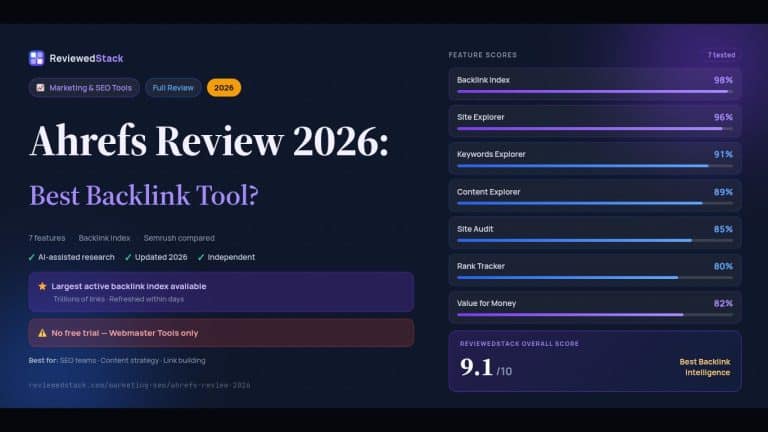
| Our Score | 9.1/10 | 9.3/10 |
| Best For | Link building | All-in-one marketing |
Ahrefs Overview
Key Features
- Backlink index and link analysis
- Keywords Explorer with traffic and SERP data
- Site Audit tool
- Content Explorer for topic and content gap discovery
- Rank Tracker
- Domain comparison and batch analysis tools
Pricing Breakdown
Note: verify current pricing on ahrefs.com. Typical tiers: Lite, Standard, Advanced, Enterprise. Annual billing typically saves about two months vs monthly.
What We Liked
- Industry-leading backlink index and fast link discovery
- Clean, focused UI that speeds up competitive research workflows
- Accurate keyword ideas and useful traffic estimates
- Strong content gap and domain comparison features
What We Didn’t Like
- Content creation and editorial workflow features are limited compared with Semrush
- No free plan – only time-limited trials
- Less breadth of non-SEO marketing integrations (ads, social, CRM)
Who Ahrefs Is Best For
SEO professionals, link builders, and content-focused teams who want fast, reliable backlink data and a streamlined research experience without the extra marketing toolset.
Semrush Overview
Key Features
- Keyword research and rank tracking
- Site audit and technical SEO
- Backlink analysis and link-building tools
- Content marketing toolkit (Topic Research, SEO Writing Assistant, Content Audit)
- Competitive intelligence (PPC and traffic analytics)
- Social media and advertising tools
Pricing Breakdown
Note: verify current pricing on semrush.com. Typical tiers: Pro, Guru, Business. Annual billing often saves ~17% vs monthly.
What We Liked
- Comprehensive all-in-one platform covering SEO, PPC, social, and content
- Rich content tools and editorial workflow support for teams
- Detailed site audits with prioritized issues and remediation guidance
- Extensive integrations (Google Ads, Analytics, social platforms, CRMs)
What We Didn’t Like
- Interface can feel cluttered and has a steeper learning curve
- Some advanced features (marketplace reports, API access) can be costly at higher tiers
Who Semrush Is Best For
Marketing managers and small business teams who need a single platform for SEO, content, PPC research, and competitive intelligence, plus collaboration features for multiple users.
Ahrefs vs Semrush – Head to Head
Keyword Research
Ahrefs’ Keywords Explorer gives you a clean list of related keywords, parent topics, estimated traffic, and a Keyword Difficulty (KD) score that many small teams use to quickly shortlist realistic targets (e.g., pick 5 low-KD informational keywords to drive blog traffic for a local bakery). You can use the SERP overview to inspect the current top-ranking pages and their estimated organic traffic so you know whether a given keyword tends to reward long-form guides or product pages. Semrush’s Keyword Magic Tool returns similarly deep coverage but layers on PPC metrics (CPC, competitive density), keyword intent filters, and automatic keyword grouping, which is useful if your small business runs occasional paid campaigns or wants site-structure-ready clusters. A practical workflow: seed a product or service term, filter by volume/KD/intent, export 50-100 candidate keywords, then build a content/landing-page plan – Ahrefs makes the list cleaner and faster, Semrush helps you map keywords to PPC and content silos. For local businesses, Semrush’s geographic filters and intent labels can speed selection of city-level keywords; Ahrefs’ parent-topic and traffic potential views help forecast realistic traffic gains from one new pillar page. Both offer APIs and CSV exports for spreadsheet-driven prioritization, but Ahrefs tends to be faster for one-off competitive lookups while Semrush is better when you want integrated PPC/contextual data at scale. Verdict: Tie – both excellent; choose Ahrefs for cleaner research workflows and Semrush if you need integrated PPC context and grouping.
Backlink Analysis
Ahrefs’ Site Explorer and Referring Domains reports are widely regarded for freshness and usable metrics like Domain Rating, new/lost link timelines, and Link Intersect (find domains linking to competitors but not you). A small e-commerce owner can run Link Intersect to compile outreach targets, then use Ahrefs’ anchor and page-level metrics to prioritize high-value prospects. Semrush provides Backlink Analytics plus a Backlink Audit tool that runs a toxic-link analysis and integrates with its Link Building Tool to manage outreach workflows and disavow lists – helpful if you’re actively cleaning harmful links or running outreach via Semrush’s campaign interface. In a real workflow, you might export competitor backlinks from Ahrefs for quick prospecting, then import prospects into Semrush’s Link Building tool to manage outreach and monitor responses; many teams use both in tandem for that reason. Ahrefs shines when you need rapid discovery and historical link growth visualizations to inform strategy, while Semrush adds workflow features (audit → remediation → outreach) that are practical for ongoing maintenance. For recovery scenarios (lost links, sudden ranking drops), Ahrefs’ “new vs lost” timeline often surfaces changes fastest, but Semrush’s toxic-score and remediation guidance can speed cleanup. Verdict: Ahrefs wins.
Site Audit
Semrush’s Site Audit offers flexible crawl settings, prioritized issues with severity levels, and descriptive remediation tips (e.g., which pages have duplicate metadata, which images need alt attributes), making it well suited for small businesses working with a developer or agency to fix problems. It can surface crawlability issues, broken links, redirect chains, and hreflang/sitemap problems and lets you schedule recurring crawls to track fixes over time; the report export and templated fixes are useful for handing to a developer. Ahrefs’ Site Audit produces a clear health score, flags common issues (broken links, slow pages, meta tags), and ties flagged pages back to organic traffic estimates so you can prioritize fixes for pages that matter most. In practice, a local service business could run Semrush to generate a prioritized ticket list for their dev, while using Ahrefs to quickly see whether fixing specific pages will likely recover lost organic traffic. For large e-commerce sites, Semrush’s deeper crawl options and issue triage scale better; Ahrefs is faster and simpler for smaller sites, with an emphasis on actionable pages rather than exhaustive diagnostics. If you need log-file analysis or enterprise-level crawl customization, Semrush’s add-ons and integrations push it ahead for advanced technical SEO workflows. Verdict: Semrush wins.
Content Tools
Semrush provides an end-to-end content toolkit – Topic Research to brainstorm headlines and subtopics, SEO Writing Assistant to score drafts against competitors and recommended keywords, and Content Audit to track performance of existing posts – which is ideal if you run a small marketing team producing a steady editorial calendar. For example, you can use Topic Research to generate 20 headline ideas, draft in Google Docs with the SEO Writing Assistant plugin, then schedule winners in Semrush’s Content Calendar and monitor traffic uplift. Ahrefs’ Content Explorer is excellent for ideation and competitive analysis: find top-performing content by shares and backlinks, discover the “parent topic” for cluster planning, and run Content Gap to find keywords rivals rank for but you don’t. A practical workflow for a one-person blog might be: use Ahrefs Content Explorer to validate topic potential by checking referring domains and organic traffic, then create the piece; if you need workflow features (editorial briefs, team review), Semrush fills that gap. Semrush also suggests semantically related keywords and readability tips, which reduce back-and-forth between writer and SEO; Ahrefs focuses on evidence-based topic selection and link potential. Verdict: Semrush wins.
Rank Tracking
Both platforms let you track positions by device and location, but Semrush’s Position Tracking tends to provide more frequent updates, richer SERP-feature visibility (featured snippets, knowledge panels, local pack), and a dedicated mobile/local tracking setup that’s helpful for multi-location small businesses. Ahrefs’ Rank Tracker is reliable, offers historical charts, and integrates position changes with estimated traffic impact so you can see which drops actually matter to revenue. In a typical workflow a restaurant owner might set up Semrush to track 50 city-specific keywords and receive daily alerts for local-pack changes, while an online niche store could use Ahrefs to monitor the impact of new backlinks on tracked e-commerce keywords. Semrush’s competitor tracking and automated alerts are useful for agencies managing several clients and needing to report quickly; Ahrefs’ cleaner reports are easier for a solo operator who wants to spot major moves without noise. Both platforms allow exporting schedules for reporting; choose Semrush if you need daily monitoring and granular SERP-feature breakdowns, choose Ahrefs for clear historical impact analysis. Verdict: Slight Semrush edge for frequency and SERP feature detail.
Ease of Use
Ahrefs is known for a clean, focused interface: key tools like Site Explorer, Keywords Explorer, and Content Explorer are logically laid out and let you get results with fewer clicks, which reduces the learning curve for a small business owner doing quick checks. Semrush packs many more modules (Social, PPC, Market Research, Content) into one product, which gives breadth but increases menu complexity – expect to spend more time learning where to find things and customizing reports. In practice, an owner who wants to do a quick competitor lookup or backlink check will likely finish faster in Ahrefs; someone building monthly cross-channel reports combining SEO, PPC, and social will invest time upfront with Semrush but then benefit from templated dashboards. Both platforms provide tutorials and support, but Semrush’s wealth of features means more learning materials and webinars; Ahrefs relies on a simpler product offering and clear documentation. If you prefer a minimal, fast workflow, Ahrefs’ UI is friendlier; if you want one tool to cover multiple marketing tasks, be prepared for Semrush’s steeper but ultimately more flexible interface. Verdict: Ahrefs wins.
Integrations
Semrush integrates broadly with Google Analytics, Google Search Console, Google Ads, major social platforms for posting/monitoring, and has connectors for data visualization tools and Zapier – this makes it practical for a small marketing team that needs consolidated reporting and automation across channels. Semrush’s API and My Reports features let you build branded reports combining SEO, PPC, and social metrics for clients or stakeholders. Ahrefs connects with Google Search Console and offers data exports and an API for customers on higher tiers, but it has fewer built-in social or ad platform integrations; it is optimized for exporting to spreadsheets or data-visualization stacks rather than managing paid/social campaigns from the same interface. A realistic workflow: use Semrush to pull paid and organic performance into one dashboard for a monthly review meeting, or use Ahrefs to run a focused backlink and keyword audit and export findings into your project management tool. If your small business relies on cross-channel automation (triggered reports, social posting), Semrush’s integrations will save time; if your focus is pure SEO analysis with occasional exports, Ahrefs’ simpler integration set is often sufficient. Verdict: Semrush wins.
Pricing
Both start at similar entry points, but the meaningful difference is in limits and included features: Ahrefs’ lower tiers emphasize core SEO metrics (keyword data, backlink lookup) with tighter limits on tracked keywords and projects, while Semrush’s mid-tiers bundle additional marketing modules (Content, Social, PPC) that can reduce the need for other subscriptions. For a small business with one website and a handful of keywords, Ahrefs’ Lite/Standard plans can offer clean, affordable access to backlink and keyword research without paying for unused marketing modules. If you run paid ads, need content workflows, or manage multiple locations, Semrush’s Pro/Guru tiers often include those extras or make add-ons available – which can be more cost-effective than subscribing to separate tools. Watch limits like monthly queries, tracked keywords, and projects: small teams that grow quickly can hit Ahrefs’ export or project caps and need to upgrade, while Semrush users might face higher costs if they activate multiple paid modules. A common practical approach is to trial both, map the features you’ll use monthly, and calculate combined value against any overlapping subscriptions (e.g., Google Ads, social schedulers). Verdict: Depends on use case – Ahrefs for specialized SEO, Semrush for broader marketing.
Our Verdict: Which Should You Choose?
Choose Ahrefs if…
- Your priority is link building and backlink research
- You want clean, fast research workflows and a simpler interface
- You focus on content gap analysis and competitive keyword exploration
Choose Semrush if…
- You need an all-in-one marketing platform that covers SEO, PPC, social, and content
- You run content at scale and want editorial tools plus collaboration features
- You want deeper technical audits and more integrations for paid/social campaigns
Consider alternatives if…
- Your budget is under ~$50/month – see SE Ranking or Mangools
- You only need technical crawling – Screaming Frog is a focused alternative
All ReviewedStack comparisons are editorially independent. Learn how we work →
FAQs
Q: Is Ahrefs or Semrush better for small business?
A: It depends. Ahrefs is better if you mainly need backlink and competitive keyword research with a clean UI. Semrush is better if you want an all-in-one marketing platform that handles SEO, content, PPC, and social.
Q: Which is better for backlink analysis – Ahrefs or Semrush?
A: Ahrefs generally leads for backlink index size, freshness, and link-quality metrics. Semrush offers solid backlink tools but is typically a step behind Ahrefs for depth.
Q: Is Semrush worth the price for a small business?
A: If your small business runs SEO plus content, PPC, or social from one team, Semrush often justifies its price through consolidated workflows and broader feature coverage. If you only need link research, it may be overkill.
Q: Can I use both Ahrefs and Semrush?
A: Yes. Many teams pair Ahrefs (backlinks/research) with Semrush (audits/content/PPC) to cover complementary needs – but it increases costs.
Q: Does Ahrefs have a free plan?
A: No. Ahrefs offers time-limited trials and limited free tools, but not a permanent free plan. If budget is a concern, see our Best SEO Tools for Small Business guide for more affordable alternatives.
Q: Is Ahrefs easier to use than Semrush?
A: Most users find Ahrefs’ interface cleaner and faster for focused SEO tasks. Semrush is feature-rich and therefore has a steeper learning curve.
Q: Which has better keyword research – Ahrefs or Semrush?
A: Both are excellent. Ahrefs is praised for clean output and reliable traffic estimates; Semrush adds PPC context, keyword grouping, and SERP-feature detail. Choose based on whether you prioritize workflow simplicity (Ahrefs) or integrated marketing data (Semrush).

Former engineering leader at HARMAN International, where he acted as business architect in SAP ME and Siemens Teamcenter PLM implementations. Built ERP and process automation applications in .NET. Holds a degree in Business Information Management. Reviews SaaS tools from the perspective of someone who has evaluated, implemented, and lived with enterprise software at scale.
LinkedIn Profile