Ahrefs Review 2026: The Best Backlink Tool — But Is It Enough?
📅 Last Updated: June 2026 ⏱ 16 min read
Most SEO tools try to do everything. Ahrefs made a different bet: be the absolute best at backlink analysis and competitive research, then build outward from there. Thirteen years later, that bet has paid off — Ahrefs runs the largest active backlink index in the industry and has become the go-to tool for SEOs who treat link analysis as a competitive advantage, not an afterthought.
This Ahrefs review covers everything you need to know: pricing, core tools, real workflow implications, and an honest comparison with Semrush — so you can decide which fits your business. Our evaluation follows our 5-point review methodology.
Table of Contents
Ahrefs — Quick Verdict
What Makes Ahrefs Different
In this Ahrefs review, we start with what sets it apart: founded in 2010 in Singapore and remains privately held. Where most SEO platforms have expanded into full marketing suites, Ahrefs has stayed focused — deepening its core capabilities rather than broadening into adjacent categories. The result is a tool that does fewer things than Semrush, but does those things with a depth and data quality that competitors consistently struggle to match.
The centrepiece of that depth is the backlink index. Ahrefs crawls the web continuously, maintaining an index that covers trillions of known backlinks across billions of pages. The index is refreshed far more frequently than most competitors, which matters in practice: new backlinks appear in Ahrefs within days of being acquired, and lost links are flagged quickly. For businesses running active link-building campaigns or monitoring competitor link acquisition, that freshness is the difference between reacting quickly and finding out too late.
The platform’s design philosophy is equally distinctive. Where Semrush presents data across dozens of tools and sub-tools — a comprehensive but occasionally overwhelming experience — Ahrefs organises its interface around five core tools. Every feature serves one of those five entry points. The result is a faster learning curve and a workflow that feels purposeful rather than exploratory.
Ahrefs Pricing 2026
Pricing is one of the key factors in this Ahrefs review — verify current rates at ahrefs.com — plans and limits change frequently.
Lite Plan
Entry-level access covering one user and limited project slots. Includes Site Explorer, Keywords Explorer, Site Audit, and Rank Tracker with restricted data history. Best for freelancers and very small businesses who need backlink and keyword data but don’t require historical analysis depth or multiple-seat access. Monthly billing carries a premium over annual.
Standard Plan
The core business plan — adds full data history access, more projects, and Content Explorer. The right tier for most small marketing teams and agencies running SEO as a primary growth channel. The Standard plan is where Ahrefs becomes a complete professional tool rather than a limited entry point.
Advanced Plan
Adds additional seats, higher limits, and access to Ahrefs’ more advanced features including web analytics integration. For growing agencies or in-house SEO teams managing large content operations or multiple client accounts.
Enterprise
Custom pricing and limits. Adds API access, SSO, and dedicated support. Relevant for agencies and larger businesses that need programmatic data access or require Ahrefs data integrated into their own reporting infrastructure.
There is no free trial. Ahrefs Webmaster Tools provides a free but limited version — restricted to sites you own and verify, covering basic backlink and organic keyword data for your own properties only. It is a useful complement to Google Search Console, not a replacement for the paid platform.
The Five Core Tools
Site Explorer — Where Ahrefs Earns Its Reputation
Site Explorer is the flagship. Enter any domain, subdomain, or specific URL and receive a comprehensive breakdown of its backlink profile, organic search traffic, and top-ranking pages. The interface is fast — data loads in seconds even for large domains — and the depth of backlink data is genuinely unmatched.
The Backlink Profile view shows every inbound link Ahrefs has indexed: the source domain, anchor text, URL rating of the linking page, date first seen, and whether the link is dofollow or nofollow. Filtering and sorting are immediate — you can isolate new links acquired in the last 30 days, find links from specific industries, or identify lost links that may need to be recovered.
The Organic Keywords view shows which keywords a domain or page ranks for, at what position, and the estimated traffic each keyword drives. For competitive research, this is where the work happens: understanding which content is driving your competitors’ organic traffic, which keywords they rank for that you don’t, and where their traffic concentration is highest.
The Top Pages report surfaces the specific pages driving the most organic traffic to any domain — not just the homepage, but the actual content that search engines are rewarding. For a content strategy built on topical authority, this report is how you find what’s working in your niche before investing in production.
Real-world use case: A 15-person B2B SaaS company uses Site Explorer to analyse the top three competitors in their niche. The Top Pages report reveals that a competitor’s detailed comparison guide is driving 40% of their estimated organic traffic from a single page. The team prioritises a more comprehensive version of that content type in their next quarter’s editorial calendar.
Standout feature: The Lost Backlinks report — showing links that previously pointed to your site but are no longer active — identifies recovery opportunities before they permanently damage domain authority. Recovering a lost link from a high-authority domain often takes a single outreach email once you know it’s gone.
Limitation: Site Explorer’s traffic estimates are models, not measurements. For your own site, Google Search Console provides accurate click data that Ahrefs cannot match. Use Ahrefs for competitive intelligence and your own sites for validated performance tracking.
Keywords Explorer — Accurate Data, Clean Interface
Ahrefs’ Keywords Explorer covers 170+ countries and provides keyword difficulty scores, search volume estimates, click-through rate projections, and SERP analysis for any query. The keyword difficulty metric is consistently cited by SEO practitioners as one of the more accurate models available — it accounts for the actual backlink profiles of pages ranking for a keyword rather than relying on simplistic volume-based scoring.
The Parent Topic feature groups related keywords under their primary cluster, helping avoid content fragmentation — a common mistake where a site creates multiple thin pages targeting keyword variations that would rank better as a single comprehensive piece. The SERP overview shows the top 10 ranking pages with their domain rating, URL rating, estimated traffic, and backlink count — giving a quick read on whether a target keyword is realistically competitive for a given site.
Real-world use case: A marketing manager at a 60-person professional services firm uses Keywords Explorer to evaluate a list of target keywords before briefing the content team. The difficulty scores immediately eliminate 40% of the list as unrealistic for the site’s current authority level, saving several weeks of content production investment.
Content Explorer — Underrated and Genuinely Useful
Content Explorer is the most underutilised tool in Ahrefs’ suite and one of the most practically useful. It indexes hundreds of millions of pages and allows searching by topic, author, domain, or any combination — returning results sorted by backlinks, organic traffic, social shares, or publishing date.
For content ideation, it surfaces what has actually earned links and traffic in a given topic area, not just what was recently published. A search for any topic returns the most link-attracting pages ever written on that subject — providing a direct signal of what the SEO community and editorial world considers linkworthy content.
For competitor content research, it reveals which specific pieces of content in your niche have driven the most inbound links — and from whom. That backlink source data is immediately actionable for outreach: the people who linked to your competitor’s content on a topic are the most likely candidates to link to a better version of the same content.
Real-world use case: A content lead uses Content Explorer to research the “SaaS onboarding” topic before commissioning a guide. The results show that two articles have accumulated significantly more backlinks than everything else on the topic combined. Both are data-driven pieces with original survey data. The team redesigns their guide to lead with proprietary survey findings rather than aggregating existing research.
Site Audit — Technical SEO Without the Noise
Ahrefs’ Site Audit crawls your site and surfaces technical SEO issues prioritised by severity. The interface is cleaner than Semrush’s audit tool — fewer categories, clearer remediation guidance, and a crawl health score that tracks over time. Issues are grouped logically: crawlability, indexability, performance, on-page, and links.
The JavaScript rendering capability covers single-page applications and dynamically rendered content, which is critical for SaaS products where much of the important content is rendered client-side. Crawl scheduling options include daily, weekly, and monthly cadences with email alerts when new issues are detected above a severity threshold.
Limitation: Site Audit’s issue count can be high on large sites, and not every flagged issue is equally impactful. The severity scoring helps, but a technical SEO background makes interpreting the output more efficient than following it mechanically.
Rank Tracker — Clean but Basic
Rank Tracker monitors keyword positions over time for tracked domains, with daily updates on paid plans and weekly on Lite. The interface is clear and the trend visualisation is good. Against Semrush’s Position Tracking, it covers the core functionality but lacks some of the SERP feature tracking (featured snippets, local packs) that Semrush surfaces.
For businesses tracking a focused keyword list, Rank Tracker is entirely sufficient. For complex SERP monitoring across multiple content types, Semrush’s tracking is more detailed.
A Note From Enterprise Experience
Working across enterprise environments — at HARMAN managing product content for global audio brands, and evaluating SEO tooling for manufacturing platforms with Teamcenter PLM and SAP ME integrations — the consistent challenge was competitive content intelligence at scale. Which competitor pages were attracting the authoritative links that drove their search visibility? Which product category pages needed link reinforcement to compete with established players?
In those contexts, Ahrefs’ Site Explorer would have been the tool of choice for exactly that analysis. Enterprise SEO is not fundamentally different from SMB SEO in its mechanics — it’s the same link signals and content quality factors, at a larger scale and with more stakeholders. What differs is the cost of a wrong content investment: a 60-page content hub built on keyword assumptions that Ahrefs’ difficulty data would have flagged as unrealistic represents months of wasted production budget.
For smaller teams, the cost of good data is proportionally even higher — a bad keyword strategy on a 12-person marketing team’s limited content budget has a larger relative impact than the same mistake at an enterprise scale with dedicated SEO resources.
Ahrefs vs Semrush: The Honest Comparison
Both tools are excellent — and this Ahrefs review wouldn’t be complete without an honest comparison. The choice depends on what you need them to do.
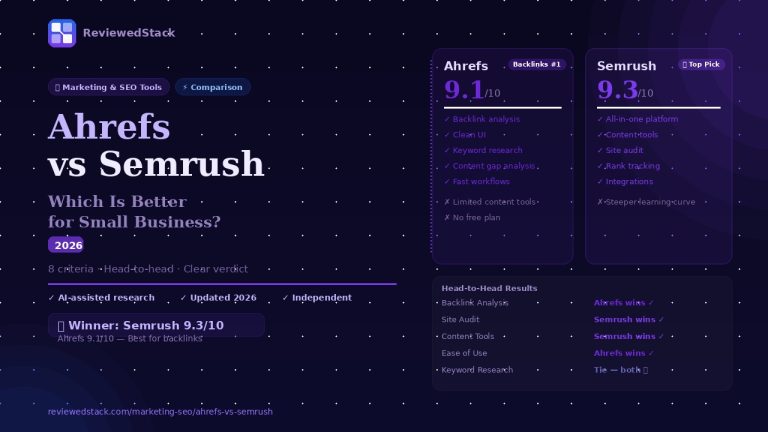
Ahrefs wins on: Backlink index size and freshness, Content Explorer for link-earning content research, UI simplicity, and data accuracy on keyword difficulty.
Semrush wins on: Feature breadth (PPC, social, content marketing tools), advertising intelligence, local SEO, and the scope of its keyword database in some markets.
Where they’re comparable: Keyword research, site audit, rank tracking, and competitive organic research.
If SEO and content are your primary growth channels and you don’t need PPC or social tools in the same platform, Ahrefs is the stronger choice. If you want a single platform covering SEO, paid advertising, and content management, Semrush’s breadth is hard to match.
For a full side-by-side breakdown, see our Ahrefs vs Semrush comparison.
Ahrefs Pros and Cons
What We Liked:
- The largest and most frequently updated backlink index available — new links appear within days of acquisition
- Site Explorer’s competitive research capabilities are unmatched in the category for SEO-focused workflows
- Content Explorer solves a specific and valuable problem — identifying linkworthy content formats in any niche — that most tools don’t address directly
- Clean, fast interface with a logical five-tool structure that is faster to learn than Semrush’s broader suite
- Keywords Explorer difficulty scores are among the most reliable in the industry for evaluating realistic ranking difficulty
What We Didn’t Like:
- No free trial — the Webmaster Tools free tier only covers your own verified sites, not the competitive research that is Ahrefs’ primary value
- No PPC or paid advertising data — a meaningful gap for businesses running both organic and paid acquisition
- Rank Tracker lacks some of the SERP feature tracking available in Semrush’s Position Tracking
- Pricing starts at a level that requires justification for very small teams with limited SEO budgets
- The platform’s focus on SEO means businesses wanting social analytics or content distribution tools must pay for additional platforms
Who Should Use Ahrefs
Based on this Ahrefs review, the tool is the right choice if:
- SEO and content marketing are your primary organic growth channels
- Link-building is a deliberate, ongoing part of your strategy — not an afterthought
- You want the most accurate competitive backlink intelligence available
- Your team is SEO-literate and will use the data depth Ahrefs provides
- You run an agency or manage SEO for multiple clients
Ahrefs is NOT the right choice if:
- You also need PPC campaign management and advertising intelligence in one platform
- Budget is tight and you need to justify a single-platform investment — Semrush’s breadth may provide more total value
- You’re new to SEO and need a tool with guided workflows and educational integration (Semrush Academy gives Semrush an edge for beginners)
- You need social media analytics as part of your marketing stack
Our Final Verdict
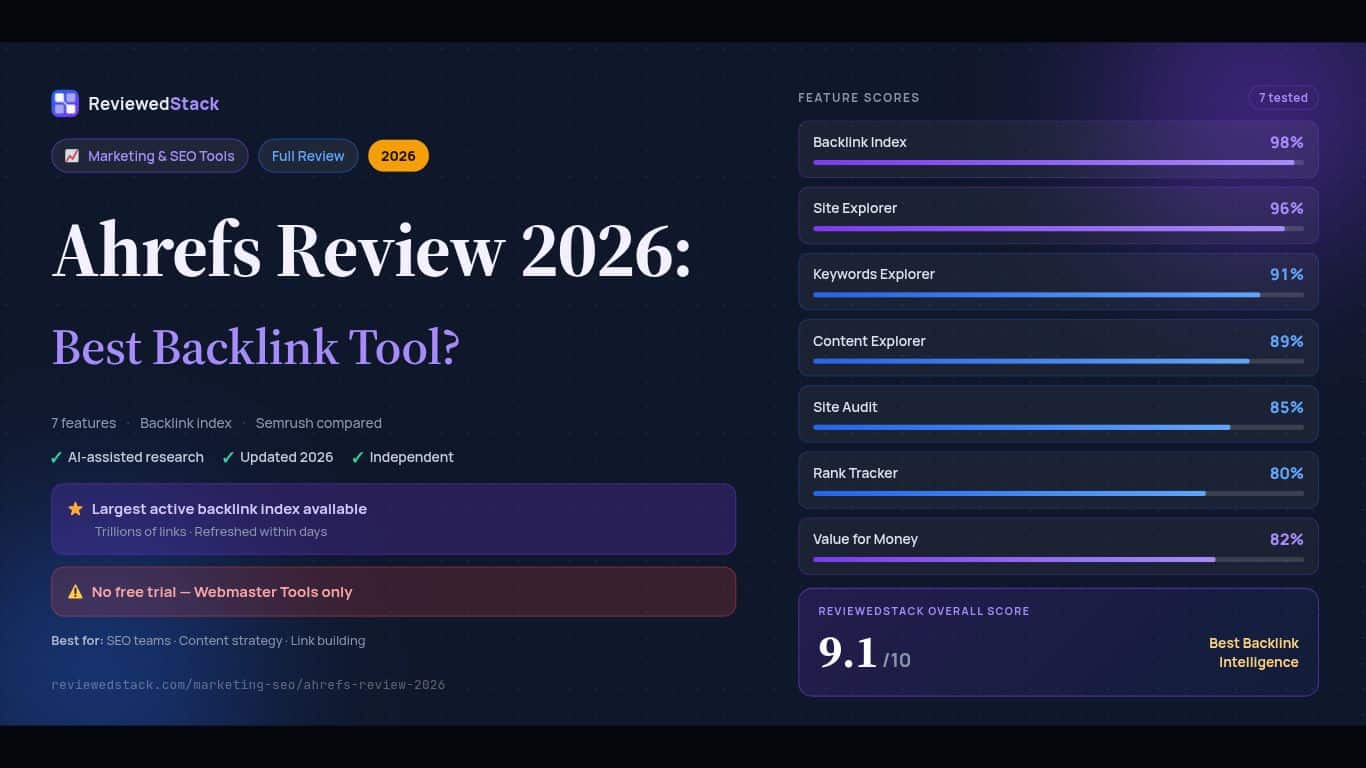
This Ahrefs review concludes with a 9.1/10 – the most powerful backlink intelligence platform available — and a genuinely excellent SEO tool beyond that core strength. The decision to go deep rather than broad has produced a product where every feature exists for a reason and works exceptionally well. Site Explorer is in a category of its own for competitive link research. Content Explorer solves a real problem that most SEO tools ignore. The interface is fast and logical.
The one clear limitation is scope: Semrush is a more complete marketing platform. Businesses that need paid search data, social analytics, or a broader content marketing suite alongside SEO will find Ahrefs leaves gaps. For pure SEO and content work, those gaps don’t exist.
This Ahrefs review is part of our broader Marketing & SEO Tools coverage, see all reviews at Marketing & SEO Tools reviews.
All ReviewedStack comparisons are editorially independent. Learn how we work →
FAQs
Q: Is Ahrefs worth it in 2026?
Yes — and this Ahrefs review confirms it for businesses where SEO and content are primary growth channels. The backlink index and competitive research capabilities justify the cost for any team running a deliberate SEO strategy. For teams where SEO is secondary to paid acquisition or social, Semrush or a more affordable alternative may provide better value per dollar.
Q: Does Ahrefs offer a free trial?
No. Ahrefs discontinued its paid trial. Ahrefs Webmaster Tools provides free access to basic backlink and keyword data for sites you own and verify — useful for monitoring your own properties, not for competitive research or the full platform experience.
Q: How does Ahrefs compare to Semrush?
As covered in this Ahrefs review, the tool has a stronger backlink index and cleaner interface. Semrush has broader feature coverage including PPC tools, social analytics, and a larger keyword database in some markets. Most SEO professionals have a preference; many agencies use both. See our Ahrefs vs Semrush comparison for a full breakdown.
Q: Is Ahrefs good for beginners?
Ahrefs is learnable but assumes some baseline SEO knowledge. The interface is clean and the documentation is thorough. For complete beginners, Semrush’s Academy and guided workflows offer a more structured onboarding. If you’re already familiar with SEO concepts, Ahrefs’ learning curve is manageable within a few weeks.
Q: What is Ahrefs Webmaster Tools?
A free product from Ahrefs that provides basic backlink and organic keyword data for sites you own and verify through DNS or HTML file verification. It shows which sites link to you, which keywords you rank for, and basic technical issues flagged by Ahrefs’ crawler. It does not provide competitor research, Content Explorer, or full Keywords Explorer access.
Q: Can Ahrefs track local SEO rankings?
Rank Tracker supports location-specific keyword tracking across multiple countries and regions. It is not as granular as Semrush’s local SEO tools for businesses dependent on map pack rankings and local citation management, but covers the rank tracking fundamentals for local keyword monitoring.
Q: How often does Ahrefs update its backlink index?
Ahrefs crawls continuously, with new backlinks typically appearing in Site Explorer within days of being acquired. The “new” and “lost” link filters in the Backlink Profile view allow filtering by date ranges as short as 24 hours for monitoring recent link activity.
Sources & Further Reading
- Ahrefs Pricing: How to Choose the Right Ahrefs Plan — pricing, plans, and how to choose
- Ahrefs — Pricing and plan documentation — plan tiers, limits, and feature availability reference
- Ahrefs — Webmaster Tools documentation — free tier feature scope and verification requirements
- G2 — Ahrefs user reviews — verified user review data for pros/cons analysis
- G2 — Ahrefs vs Semrush comparison data — user-reported feature comparison reference
- Ahrefs — Keywords Explorer documentation — keyword difficulty methodology and database coverage

Former engineering leader at HARMAN International, where he acted as business architect in SAP ME and Siemens Teamcenter PLM implementations. Built ERP and process automation applications in .NET. Holds a degree in Business Information Management. Reviews SaaS tools from the perspective of someone who has evaluated, implemented, and lived with enterprise software at scale.
LinkedIn Profile