Best Email Marketing Platforms for Small Business in 2026
📅 Last Updated: April 2026 ⏱ 13 min read
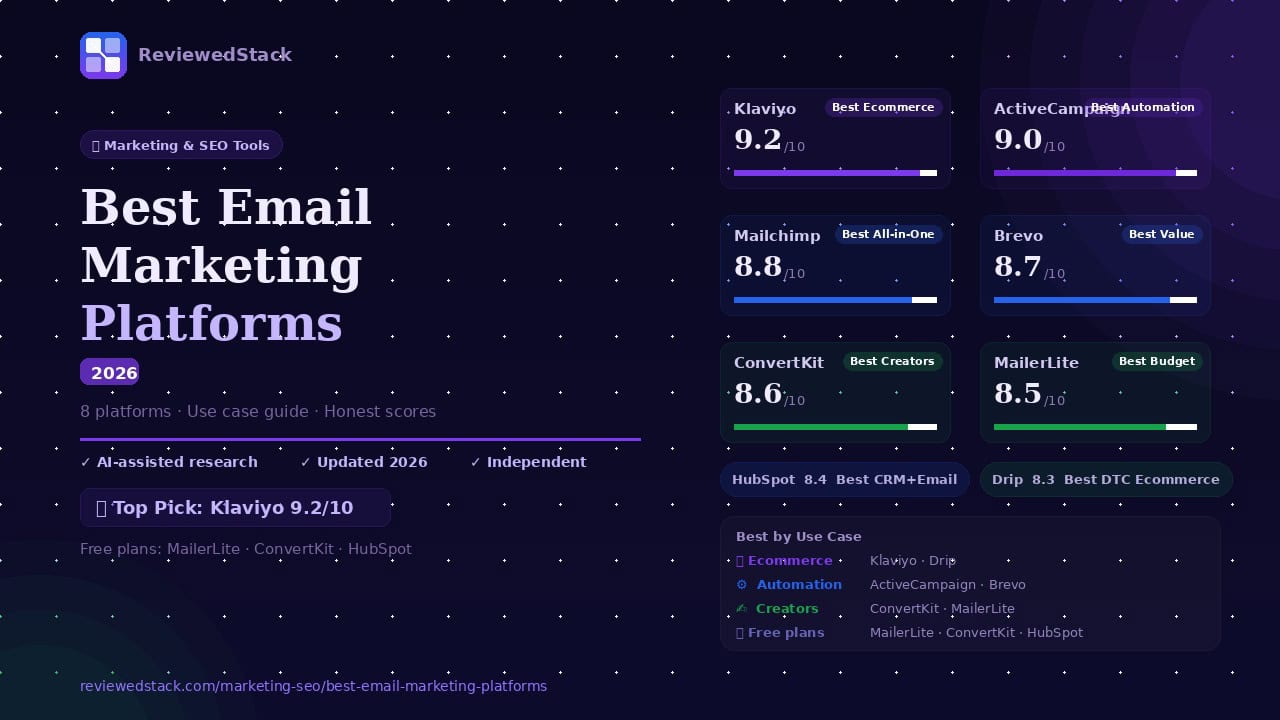
Email marketing still delivers the highest ROI of any digital channel – but only if you’re using the right platform for your list size and goals. This article covers the 8 best email marketing platforms for small businesses in 2026, with quick comparisons, strengths/weaknesses, and use-case recommendations. Methodology: we evaluated features, deliverability, pricing, ease of use, and integrations using our 5-point review methodology.
Table of Contents
Quick Comparison Table
| Tool | Best For | Free Plan | Starting Price | Score |
|---|---|---|---|---|
| Mailchimp | Best All-in-One | ✅ 500 contacts | $13/mo | 8.8/10 |
| Klaviyo | Best for Ecommerce | ✅ 250 contacts | $20/mo | 9.2/10 |
| ActiveCampaign | Best Automation | ❌ | $15/mo | 9.0/10 |
| Brevo | Best Value | ✅ 300/day | $9/mo | 8.7/10 |
| ConvertKit | Best for Creators | ✅ 1,000 subs | $25/mo | 8.6/10 |
| MailerLite | Best Budget | ✅ 1,000 subs | $9/mo | 8.5/10 |
| HubSpot Email | Best CRM+Email | ✅ 2,000/mo | $20/mo | 8.4/10 |
| Drip | Best for DTC | ❌ | $39/mo | 8.3/10 |
Note: Pricing and free plan limits verified April 2026. Always check vendor site for current rates – email platform pricing changes frequently.
The Best Email Marketing Platforms
1. Klaviyo – Best for Ecommerce
What it is: Klaviyo is an ecommerce-first email and SMS platform built for revenue attribution and deep behavioural personalization.
Key features:
- Deep Shopify/WooCommerce integration
- Behavioural segmentation and flows
- Predictive analytics and CLV scoring
- SMS marketing alongside email
- Pre-built ecommerce automation flows
Free plan: up to 250 contacts, 500 emails/month
Pricing: verify on vendor site
Pros:
- Exceptional ecommerce data and revenue reporting
- Powerful segmentation tied to purchase behaviour
- Strong template and flow library for stores
Cons:
- Can be expensive as lists and event volume grow
- Steeper learning curve than basic builders
Evaluation: Klaviyo dominates ecommerce because it surfaces purchase intent and lifetime value in ways generalist tools don’t. Its native Shopify/WooCommerce hooks and predictive metrics make it easy to build revenue-driven flows (cart abandonment, win-back, product recommendations). That depth is ideal for merchants focused on ROI, though smaller sellers should watch costs and setup complexity.
2. ActiveCampaign – Best for Automation
What it is: ActiveCampaign is an automation-first platform that combines email, workflows, and a built-in CRM.
Key features:
- Visual automation builder with conditional logic
- Built-in CRM and deal pipelines
- Lead scoring and contact tagging
- Integrations with ecommerce and landing pages
- Advanced split-testing and attribution tools
Free plan: none
Pricing: verify on vendor site
Pros:
- Most powerful automation builder for SMBs
- CRM included for sales/marketing alignment
- Excellent for lead nurturing and multi-step journeys
Cons:
- Interface and features can overwhelm beginners
- Some advanced features locked behind higher tiers
Evaluation: ActiveCampaign’s automation depth is the standout: conditional workflows, event triggers, and CRM actions let small businesses mimic enterprise-level nurture flows. There’s a learning curve, but the payoff is higher conversion and better-qualified leads when you invest time in setup. It’s the best pick if automation is core to your growth plan.
3. Mailchimp – Best All-in-One Platform
What it is: Mailchimp is a widely recognized all-in-one marketing platform offering email, landing pages, ads, and simple automation.
Key features:
- Drag-and-drop email and landing page builder
- Audience management and basic automations
- Social posting and ad integrations
- Pre-built templates and content studio
- Reporting dashboard for campaigns
Free plan: up to 500 contacts
Pricing: verify on vendor site
Pros:
- Easy to get started with generous free tier
- All-in-one tools for small teams (landing pages, social)
- Recognizable brand and strong onboarding resources
Cons:
- Automation and advanced segmentation are limited vs specialists
- Cost rises as audience and feature needs grow
Evaluation: Mailchimp is best for beginners who want a simple, integrated toolset to run email, basic automations, and landing pages without stitching multiple apps together. It’s not as deep on ecommerce analytics or advanced workflows, but it provides an approachable path from first newsletter to a growing marketing stack.
📖 See our full Mailchimp vs HubSpot comparison.
4. Brevo – Best Value Platform
What it is: Brevo (formerly Sendinblue) is a volume-based email and SMS platform that charges by sends, not contacts, offering strong value for large lists.
Key features:
- Sends-based pricing (pay by email volume)
- Transactional email and SMTP service
- SMS campaigns and marketing automation
- Simple CRM and forms
- Email personalization and segmentation
Free plan: 300 emails/day, unlimited contacts
Pricing: verify on vendor site
Pros:
- Excellent value for large contact lists
- Unlimited contacts on free plan
- Solid transactional email deliverability
Cons:
- Daily sending cap on the free plan can be limiting
- Automation features aren’t as advanced as top-tier tools
Evaluation: Brevo’s sends-based pricing is ideal for businesses with very large contact databases but relatively low send frequency – you pay for volume, not contact count. It’s a practical choice for service businesses and newsletters that need affordability without sacrificing core automation and transactional functionality.
5. ConvertKit – Best for Creators and Newsletters
What it is: ConvertKit (rebranded as Kit in 2024, but known as ConvertKit for SEO) is built around creators and newsletter-first workflows.
Key features:
- Subscriber-focused tagging and segmenting
- Creator-centric funnels and paid-subscription tools
- Simple automation visual builder
- Landing pages and forms optimized for list growth
- Integrations with membership and course platforms
Free plan: up to 1,000 subscribers
Pricing: verify on vendor site
Pros:
- Clean, creator-focused experience and UI
- Strong monetization tools for newsletters and paid products
- Generous free tier for growing audiences
Cons:
- Fewer advanced ecommerce features compared with Klaviyo
- Simpler automation may limit complex journeys
Evaluation: ConvertKit shines for bloggers, podcasters, and creators focused on audience growth and monetization. Its UX prioritizes subscriber management and paid-subscription workflows, making it easy to turn an audience into recurring revenue without the complexity of ecommerce-first platforms.
6. MailerLite – Best Budget Option
What it is: MailerLite is a straightforward, affordable email platform offering a strong price-to-feature ratio for small teams and freelancers.
Key features:
- Drag-and-drop builder and rich template library
- Automation workflows and landing pages
- Built-in photo editing and content blocks
- Affordable paid tiers with generous sending limits
- Simple segmentation and A/B testing
Free plan: up to 1,000 subscribers, 12,000 emails/month
Pricing: verify on vendor site
Pros:
- Excellent value for money and intuitive UI
- Generous free plan for small newsletters
- Fast setup and reliable sending
Cons:
- Less advanced automation than ActiveCampaign or Klaviyo
- Integrations and ecosystem are smaller than top brands
Evaluation: MailerLite is a top pick for budget-conscious businesses that still need a polished email and landing-page experience. It covers the essentials with fewer bells and whistles, making it an efficient choice for freelancers, local services, and small e-commerce sellers on a tight budget.
7. HubSpot Email – Best for CRM-First Businesses
What it is: HubSpot Email is the email component of HubSpot’s Marketing Hub, tightly integrated with HubSpot CRM and the platform’s contact/deal data.
Key features:
- Native integration with HubSpot CRM and contact properties
- Automated campaigns based on deal/contact stages
- Personalization using CRM fields and activity data
- Landing pages, forms, and workflows within the HubSpot ecosystem
- Reporting tied to pipelines and revenue metrics
Free plan: 2,000 emails/month with HubSpot CRM
Pricing: verify on vendor site
Pros:
- Deep marketing-sales integration when using HubSpot CRM
- Strong reporting that ties email to deals and revenue
- Good free tier for CRM users starting email campaigns
Cons:
- Email capabilities are best leveraged within the full HubSpot suite
- Can be expensive to scale beyond basic tiers
Evaluation: HubSpot Email makes most sense if you already use HubSpot CRM – the combined data model enables highly contextual campaigns that align with sales pipelines. For teams that need marketing and sales to share a single source of truth, HubSpot is a compelling choice; standalone users may find the cost and complexity higher than necessary.
📖 See our full Mailchimp vs HubSpot compariso.
8. Drip – Best for DTC Ecommerce Brands
What it is: Drip is an ecommerce-focused email platform that balances powerful automation with a simpler UX than Klaviyo.
Key features:
- Behavioural-based automations and tagging
- Ecommerce data syncs and purchase tracking
- Visual workflow builder for customer journeys
- Segmentation focused on purchase patterns and engagement
- Integrations with major ecommerce platforms
Free plan: none
Pricing: verify on vendor site
Pros:
- Easier to use than Klaviyo with solid ecommerce features
- Strong automation for lifecycle marketing
- Good for teams that want power without too much complexity
Cons:
- Smaller ecosystem and fewer native integrations than Klaviyo
- Advanced analytics and predictive models are less mature
Evaluation: Drip suits DTC brands that want Klaviyo-like automation without the heavier learning curve and enterprise ecosystem. It delivers strong segmentation and lifecycle mapping, making it a practical middle ground for merchants focused on retention and repeat purchases.
What to Look for in an Email Marketing Platform
List Size and Pricing Model
Contacts-based vs sends-based – contacts-based pricing charges per stored subscriber (best when you send frequently to a moderate list); sends-based pricing charges per email volume (best when you have huge lists but low send frequency). Choose based on your list growth plan and campaign cadence.
Automation and Flows
Look for behavioural triggers, conditional splits, and multi-channel support (email + SMS). Automation drives most of email marketing ROI through welcome sequences, cart recovery, and re-engagement flows.
Ecommerce Integration
Native integrations (Shopify, WooCommerce, BigCommerce) provide richer customer events and product data. Native is preferable to third-party middleware for revenue attribution and realtime triggers.
Deliverability
Good deliverability matters more than extra features for small lists – platform reputation, sending infrastructure, and guidance on list hygiene affect inbox placement and open rates.
Templates and Design
Drag-and-drop builders with responsive templates cover most small-business needs; HTML editors are useful if you have in-house designers. Focus on personalization and mobile-first layouts.
Free Plan Comparison
Compare who offers the most value: MailerLite and ConvertKit offer large free subscriber allowances (1,000 subs), HubSpot gives 2,000 emails/month linked to its CRM, and Brevo’s free plan offers unlimited contacts but a 300 emails/day cap.
Email Marketing Platforms by Use Case
Best for Ecommerce
→ Klaviyo (Shopify/WooCommerce)
→ Drip (DTC brands)
Best for Service Businesses
→ ActiveCampaign (automation)
→ Brevo (value)
Best for Creators & Newsletters
→ ConvertKit
→ MailerLite (budget)
Best Free Plans
→ MailerLite (1,000 subs free)
→ ConvertKit (1,000 subs free)
→ HubSpot (2,000 sends/month)
Our Verdict
Best overall by use case – Klaviyo for ecommerce, ActiveCampaign for automation, and Mailchimp for beginners.
Best budget options – MailerLite and Brevo deliver strong capability at low cost and are excellent choices for small teams and large, infrequently-sent lists respectively.
Start with a free plan, get comfortable with automation basics, and upgrade when your list grows or you need deeper integrations. See more reviews in Marketing & SEO Tools reviews.
All ReviewedStack comparisons are editorially independent. Learn how we work →
FAQs
Q: What is the best email marketing platform for small business in 2026?
A: It depends on use case – Klaviyo for ecommerce revenue optimization, ActiveCampaign for advanced automation and CRM-driven workflows, and Mailchimp for beginners who want an all-in-one start.
Q: Which email marketing tool has the best free plan?
A: For subscriber allowance, MailerLite and ConvertKit offer the most generous free subscriber limits (1,000). HubSpot provides 2,000 free sends tied to its CRM, while Brevo offers unlimited contacts with a 300 emails/day free cap.
Q: Is Mailchimp still worth it in 2026?
A: Yes – it remains a strong all-in-one choice for beginners and small teams thanks to ease of use, landing pages, and a generous free plan. Larger or ecommerce-first businesses may outgrow it for advanced automation or revenue attribution.
Q: What is the best email marketing platform for ecommerce?
A: Klaviyo is generally best for ecommerce merchants needing deep integration and revenue analytics; Drip is a good, simpler alternative for DTC brands.
Q: Is Klaviyo better than Mailchimp?
A: For ecommerce and revenue-driven segmentation, Klaviyo is better. For generalist use, simplicity, and an all-in-one approach, Mailchimp is often a better starter option. For a full platform overview, see our Best Email Marketing Platforms guide.
Q: What is the cheapest email marketing platform?
A: “Cheapest” depends on your volume model – MailerLite and Brevo are among the most affordable for small to medium senders; Brevo can be cheapest for very large contact lists due to sends-based pricing.
Q: Which email platform is best for newsletters and creators?
A: ConvertKit and MailerLite are top choices for creators and newsletters – ConvertKit for monetization features and creator flows, MailerLite for budget-friendly, reliable sending.

Former engineering leader at HARMAN International, where he acted as business architect in SAP ME and Siemens Teamcenter PLM implementations. Built ERP and process automation applications in .NET. Holds a degree in Business Information Management. Reviews SaaS tools from the perspective of someone who has evaluated, implemented, and lived with enterprise software at scale.
LinkedIn Profile